
A product of

Beyond Automation.
Into Autonomous Execution.
NerdAgent is not another AI tool.
It is a full-stack Agentic AI Operating System (AI OS) designed to plan, decide, and execute not just respond.
What you get
- Autonomous agents that reason + act
- Multi-agent systems that collaborate
- Real-time execution across your existing stack
- Production deployment in minutes, not months
From AI Outputs
From AI Outputs
The Execution Gap
The Engineering Bottleneck
Fragile Automation
The No-Code Trap
What NerdAgent Actually is
NerdAgent provides a unified runtime environment where:
- Agents are first-class compute units
- Workflows are dynamic graphs (not static flows)
- Memory is persistent + queryable
- Execution is event-driven + API-connected
How NerdAgent Works
(AI OS Architecture)
The 8-Layer AI OS Stack
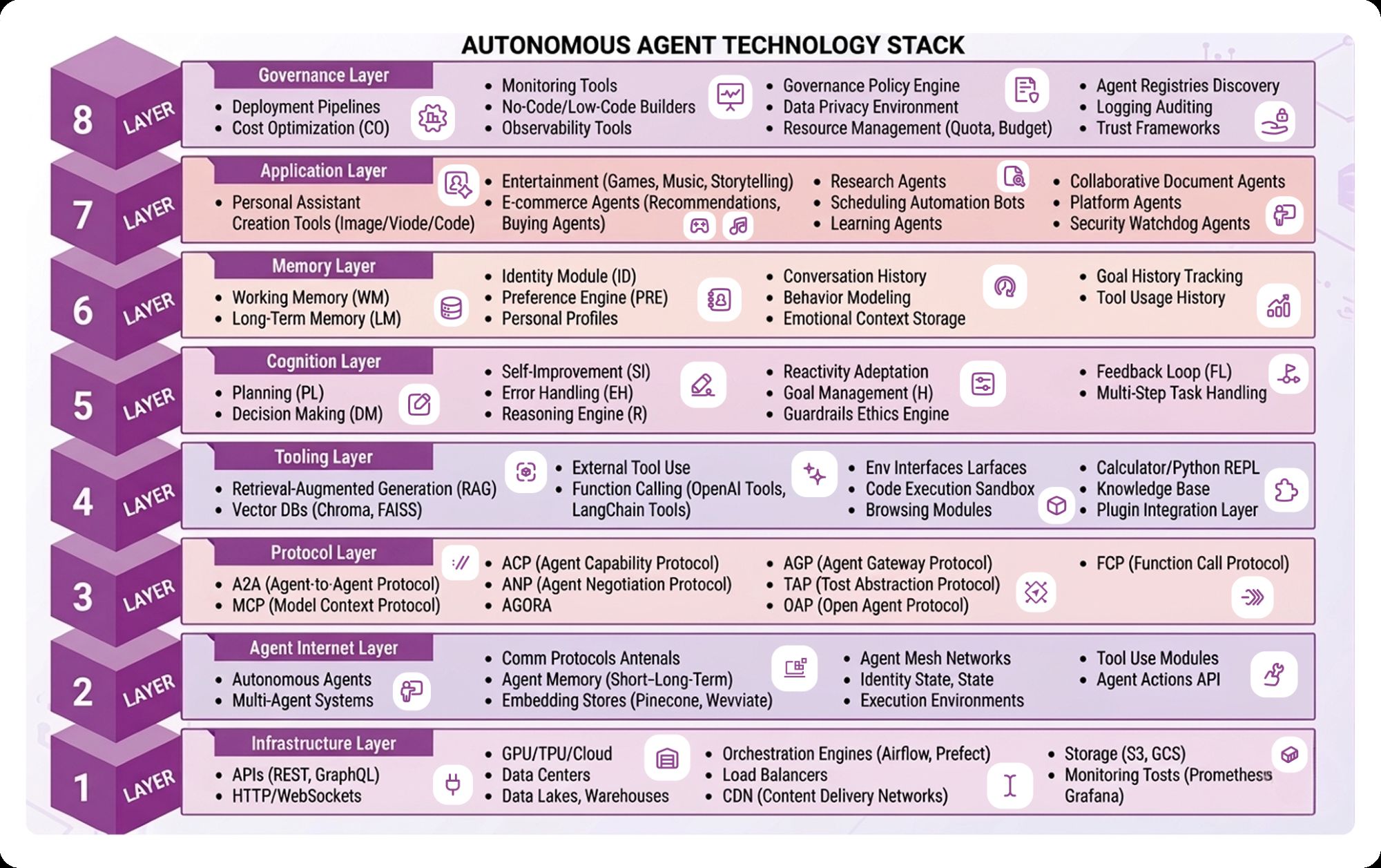
Layer 1
Infrastructure Layer
Integrate AI into existing systems with ease, when needed.
The compute foundation
APIs (REST, GraphQL)
GPU / TPU / Cloud
Data
Lakes / Warehouses
Orchestration Engines (Airflow,
Prefect)
Storage (S3, GCS)
Monitoring
(Prometheus, Grafana)
What this means
NerdAgent sits above infra,
not tied to any provider → cloud, on-prem, hybrid.
Layer 2
Agent Internet Layer
The runtime for autonomous agents.
Multi-agent systems
Agent mesh networks
Execution
environments
Embedding stores (Pinecone,
Weaviate)
Agent Actions APIs
Key Idea:
Agents are not isolated → they
exist in a networked execution fabric.
Layer 3
Protocol Layer
Standardized communication.
A2A (Agent-to-Agent)
MCP (Model Context
Protocol)
ACP, ANP, AGP, TAP, OAP
Why it matters:
This enables
interoperability + composability of
agents.
Layer 4
Tooling Layer
RAG (Retrieval-Augmented Generation)
Vector DBs
(Chroma, FAISS)
Function calling (OpenAI tools,
LangChain)
Code execution sandbox
Browsing
modules
Plugin integrations
Key Insight:
This is where
AI becomes actionable, not just
generative.
Layer 5
Cognition Layer
Planning (PL)
Decision Making (DM)
Reasoning
Engine
Goal Management
Self-improvement
loops
Error handling
Guardrails / ethics
engine
This is critical:
This layer converts:
input
→ structured reasoning → executable plans
Layer 6
Memory Layer
Working memory (session context)
Long-term
memory
Identity module
Preference engine
Behavior
modeling
Goal history tracking
Tool usage
history
Why this matters:
Agents evolve → not
stateless → context-aware systems
Layer 7
Application Layer
Support agents
Research agents
Document
agents
Scheduling bots
E-commerce agents
Security
watchdogs
Layer 8
Governance Layer
Enterprise control plane.
Policy engine
Data privacy enforcement
Observability
Logging
& auditing
Resource quotas
Trust
frameworks
Bottom line:
This makes NerdAgent
enterprise-ready by design
Execution Flow
Goal Definition
Input converted into structured objective
Cognition Layer
Planning + reasoning generate execution steps
Orchestration Layer
Tasks distributed across agents
Memory Layer
Context retrieved (history, preferences, knowledge)
Tooling Layer
Input converted into structured objective
Agent Collaboration
Agents communicate via A2A protocols
Governance Layer
Policies enforced + actions logged
Response + Action
Output + real-world execution
Core Capabilities
(Powered by AI OS)
Document AI
OCR + LLM extraction + summarization
Memory & Context
Short-term + long-term vector memory
Multi-Model Orchestration
GPT-4 / Claude / Gemini switching
Workflow Automation
Trigger actions across 1000+ tools
One-Click Deployment
GitHub → AWS/Azure/GCP
Security & Guardrails
PII masking + policy enforcement
For Developers & Power Users
Full Control When You Need It
API-first architecture
Inject custom Python / JS logic
Real-time
low-latency execution
Extend via plugins, tools,
functions
Key Positioning
Start no-code → scale to full engineering controlReal-World Use Cases
Contact Centers → Automated support agents
Healthcare →
Patient assistants + analysis
Finance → Risk & fraud
automation
Telecom → Network intelligence agents
Dev
Teams → AI feature deployment
Frequently Asked Questions
How is NerdAgent different from a chatbot or single AI
model?
Traditional chatbots respond only to direct prompts using a single model. In contrast, NerdAgent is an AI Operating System for agents. It runs multiple agents and models in parallel, each with its own goal, and orchestrates them to solve complex tasks end-to-end. It also maintains state and memory across interactions. In short, NerdAgent builds autonomous workflows, not just single-shot answers.
What kind of memory does NerdAgent use?
Can I train or fine-tune the models within NerdAgent?
What integration options are available?
How do you ensure security and compliance?
Ready to transform your
AI initiatives into agentic
workflows?
Get started with NerdAgent today
Why Teams Choose
NerdAgent
Reduce operational overhead
Faster decision cycles
Lower implementation cost
Scale AI without infra complexity
Improve CX with autonomous systems
Get started
- 243 Willis Ave, Mineola, NY, 11501-2432
- +1 (781) 953-0902
© 2026 NerdAgent.ai